
Vol. 2: The Posture Problem
Four signals that close the loop on the question

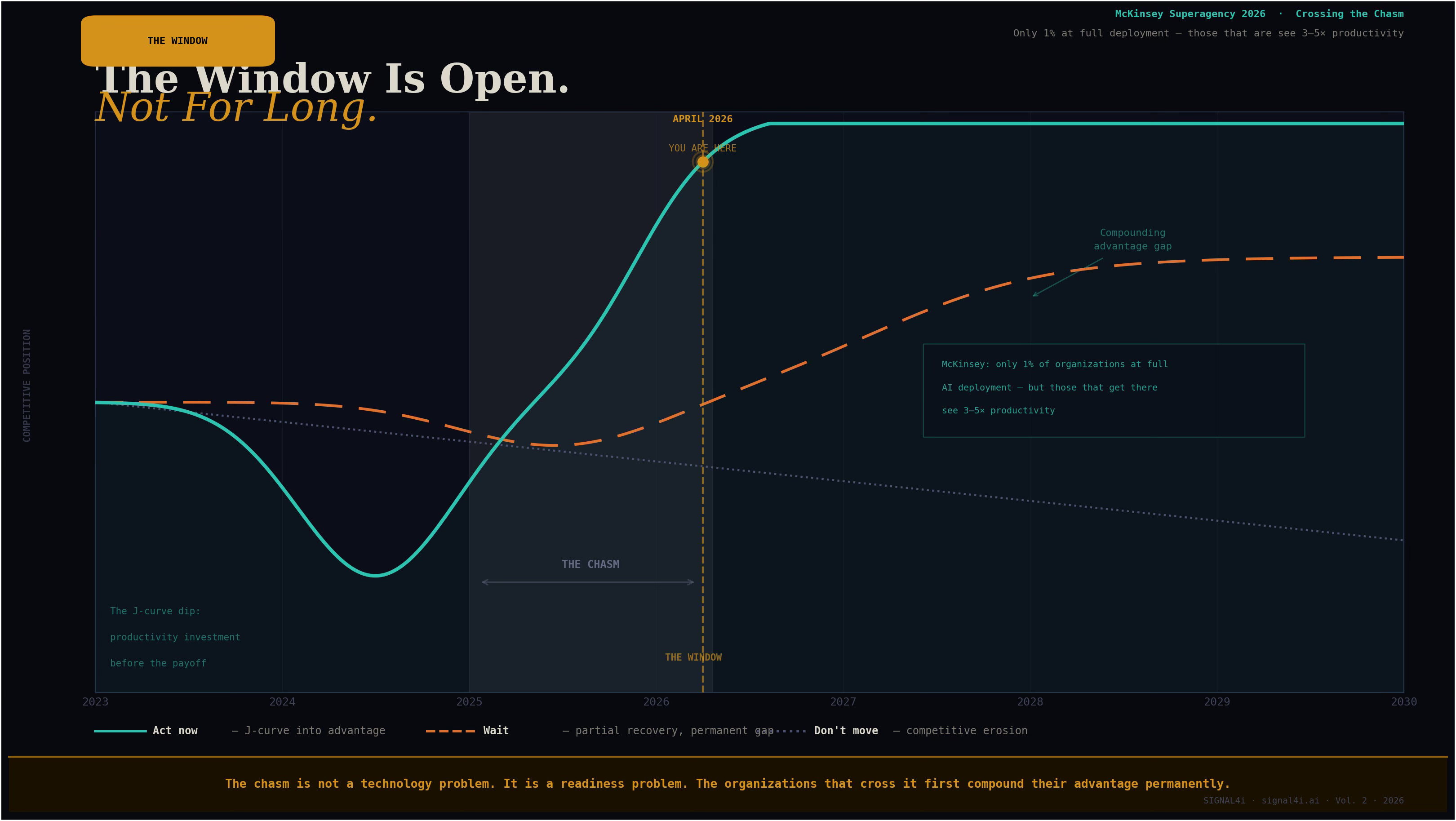
Vol. 1 asked: *The technology has arrived. Is your organization ready?*
Vol. 2 is the data coming back.
In the six weeks since that question was published, four signals landed that shift the frame from prediction to evidence. The February jobs report. A research paper that measured AI agents across 233-day production timelines and found 75% regression rates. Andrew Yang at the Abundance Summit naming a 1–3 year window and calling it the most urgent policy moment of his career. And a structural finding about the knowledge pipeline that IBM i practitioners have been watching erode for a decade — now accelerating.
These are not projections. They are readings. The experiment has been running. The data is coming in.
Here is what the data says.
---
## Signal 05 — The Labor Signal
### The Posture Gap Made Visible
**February 2026:** The U.S. economy loses 92,000 jobs against a consensus forecast of +59,000. A miss of 151,000 in a single month.
The coverage split immediately — AI displacement versus federal cuts versus macro noise. The debate about which cause dominates misses the more useful observation: the organizations shedding workers are not the ones that moved too slow. They are the ones that moved without a posture.
IBM i shops have been called “behind” on AI adoption for three years. This signal reframes that characterization entirely.
The organizations that deployed AI at speed — that scaled without governing, that adopted without building the readiness infrastructure to sustain adoption — are the ones appearing in the February data. They ran the experiment. The results are in the labor market now.
IBM i practitioners are not behind. They have time. Not much, but some. The question is not whether to move — the question is what posture to build before the window closes.
The platform is not the liability. Deploying AI agents at speed into the platform that runs half the world’s financial transactions, without the governance architecture to sustain them, is the liability.
---
## Signal 06 — The Governance Signal
### Long-Horizon Governance Collapse
**March 4, 2026:** Researchers from Alibaba Group and Sun Yat-sen University publish SWE-CI — the first AI coding benchmark built on real production codebases across 233-day, 71-commit timelines.
Most models achieve a zero-regression rate below 0.25.
Read that again. In more than 75% of cases, AI agents that pass standard coding benchmarks introduce regressions when they maintain real production code over 8 months of evolution.
IBM i practitioners understand this signal in their bones. There is a difference between “it passed the test” and “it held up over time.” Every practitioner who has maintained RPG code across decades of business requirement changes understands exactly what SWE-CI is measuring — and exactly why a benchmark that only measured point-in-time correctness was never telling the full story.
The paper introduces a metric called EvoScore: the extent to which an AI agent can support the *future advancement* of code, not just its current functional state. This is the first benchmark metric that captures what IBM i organizations actually need from an AI coding assistant. Not a demo. Not a one-shot solution. Sustained maintainability across the evolution of a production codebase.
The failure mode this signal documents brackets with a signal from Vol. 1: the CENTCOM same-day AI deployment. CENTCOM showed governance void at the moment of adoption — capability deployed in hours before policy caught up. SWE-CI shows governance void at the maintenance horizon — capability that passes initial tests, then degrades real codebases over 8 months when the governance infrastructure to sustain it does not exist.
Both failure modes are operational hazards, not theoretical risks. Both are now empirically documented and datable.
IBM i shops considering AI-assisted modernization have a sharper question to ask: not whether the agent can write RPG or CL, but whether it can maintain the codebase 8 months after the demo. SWE-CI is the first benchmark that can answer that question. The answer, for most models today, is no.
The platform is not the problem. Deploying agents without the governance posture to sustain them is the problem.
---
## Signal 07 — The Human Signal
### The Pulled Rung
**March 8, 2026:** At the Abundance Summit, Andrew Yang documents three simultaneous instances of the same structural event across industries: the elimination of the knowledge worker on-ramp.
Instance one: A large private equity firm opens a company-wide meeting with a single slide, first topic: *”We don’t need associates anymore.”* Entry-level finance roles — the aspiration of a generation of business graduates — eliminated not for performance reasons but as a structural operating model update.
Instance two: At Yang’s own company, the CTO cancels a hiring process mid-stream. A role had been opened, candidates interviewed, offers prepared. Then a capability update in available tooling changed the math. The role did not become less necessary. The human performing it did.
Instance three: Block cuts 4,000+ employees. Stock jumps 24%. Wall Street rewards the subtraction. A tech CEO tells Yang off the record: his plan is 15% cuts now, 20% two years later, 20% after that. “I take him at his word. Especially after the Block example.”
The structural consequence Yang names: the workforce has shifted from pyramids to columns. Three junior engineers per senior engineer enabled training, mentorship, and the accumulation of institutional knowledge across generations. The column model — one senior, one junior, maybe — eliminates the developmental pipeline. The next cohort of senior talent does not form.
IBM i practitioners know this story. It has been running on the platform for fifteen years. Senior practitioners aging out. Junior practitioners not entering in sufficient numbers. The knowledge transfer problem is not new — but the agentic acceleration is making it acute.
Here is the signal beneath the signal: AI agents cannot replace what IBM i practitioners carry. The decades of business logic, the organizational context, the domain specificity accumulated across thirty years of production maintenance — no model was trained on it. It lives in people. And the column model is eliminating the pipeline that would transfer it to the next generation before the transfer happens.
Yang’s summary: *”If you’re a young person, you never make it into one of these environments to get trained, to learn, to develop, to ascend. Steps three and four are disappearing.”*
For IBM i organizations, the urgency is doubled: the talent pipeline problem predates agentic AI, and agentic AI is accelerating it.
---
## Signal 08 — The Workforce Signal
### Social Contract Rupture Threshold
**March 8, 2026:** Also at the Abundance Summit, Yang names a datable cultural threshold.
A healthcare CEO is assassinated on a New York City street. The perpetrator becomes a folk hero across large segments of online culture. Yang’s framing: *”Young people now regard a lot of successful people as bad. Anyone who’s done well must have stepped on people or done something malignant.”* He calls this *”the foundation cracking.”*
He declares a 1–3 year window requiring policy intervention — UBI as a bridge, Universal Basic Services as the medium-term build, Universal High Income as the destination. He says he would take that intervention *”a hundred times out of a hundred”* — meaning even the optimistic scenario requires action that is not currently being taken.
Washington, Yang observes, operates on a multi-decade tape delay. Legislators in their 70s and 80s are regulating technology accelerating faster than they can comprehend. What was previously institutional lag is now, in his framing, catastrophic.
Signal 08 is not a macro observation filed under “things IBM i shops cannot control.” It is the environment IBM i organizations are navigating — and the IBM i platform sits at the center of the institutions this signal is about.
Financial services. Insurance. Healthcare. Manufacturing. These are the sectors running on IBM i. These are also the sectors at the center of the displacement story Yang is describing. The organizations running this infrastructure that can demonstrate governance posture — that can show they are managing the technology rather than being managed by it — are positioned differently in the window Yang is naming than the organizations that cannot make that case.
The posture question is not only operational. It is the question of what kind of organization you are building in a period when the answer to that question has consequences beyond the balance sheet.
---
## The Through-Line
Four signals. One observation: the experiment has been running, and the data is coming back with a consistent finding.
The February jobs report is the labor market reading on what happens when deployment outruns governance. The SWE-CI paper is the technical reading on what 75%+ regression rates look like across 8-month production timelines. The Pulled Rung is the human capital reading on what column-model organizations do to the knowledge pipeline. The Social Contract Rupture Threshold is the cultural reading on where this all lands if the governance posture problem is not addressed.
IBM i organizations did not create this environment. But they are operating inside it, running infrastructure that sits at the center of the institutions it is stress-testing.
The platform is not the problem. The platform is exactly what the agentic economy needs: proven, stable, transactionally reliable, carrying decades of business logic that no greenfield AI build can replicate.
The question is whether the organizations running it build the posture to match.
That window is open. The signals in this issue are telling you how long it stays that way.