
The Capex Reckoning....
What It Means for IBM i

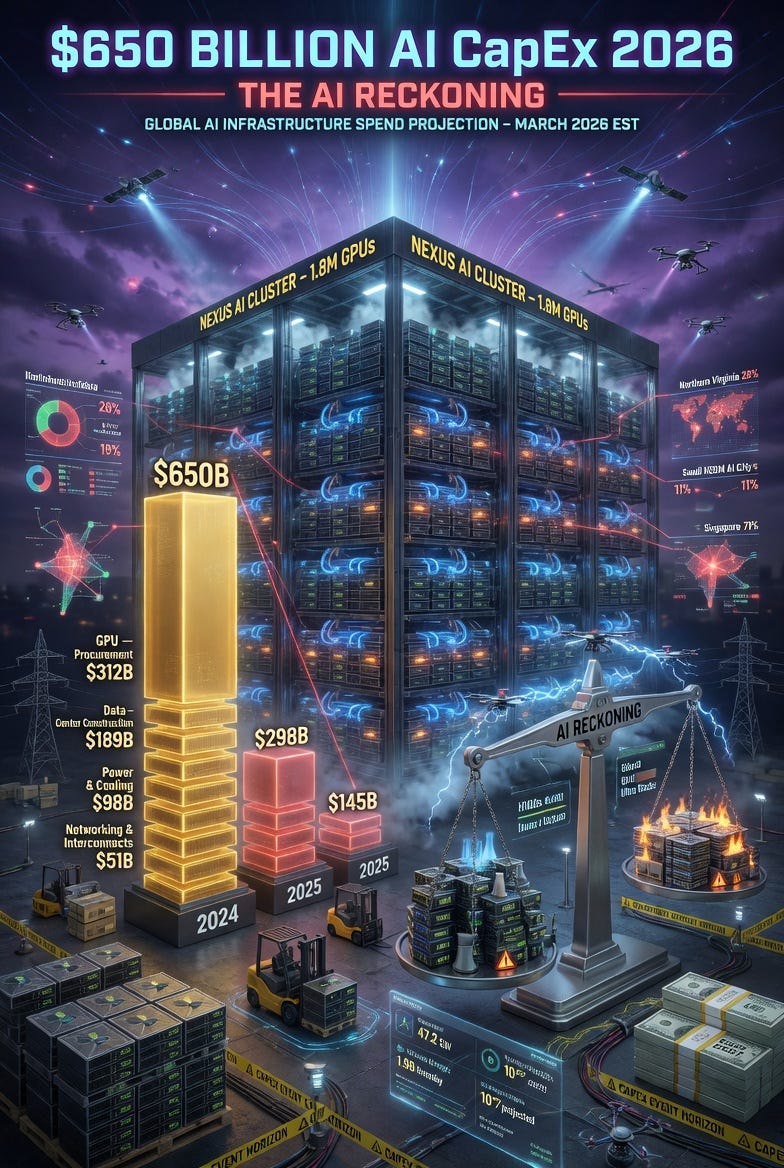
I published a white paper this week called *The Capex Reckoning*. It is written for a general enterprise and capital markets audience. It does not mention IBM i by name more than once.
That was intentional. The argument is bigger than our platform.
But the implications for IBM i shops are specific, significant, and almost entirely missing from the conversation happening in our community right now. So this is the Signal4i version — the IBM i read of a story that is unfolding at the macro level and landing directly on your infrastructure decisions whether you know it or not.
---
## The Argument in Brief
Research Affiliates CEO Chris Brightman published analysis this month showing that AI hardware has an economic life of approximately three years, while companies depreciate it over five to six years. Nvidia H100 GPUs that generated 137% ROI in year two are generating negative 34% ROI by year four. The gap between accounting life and economic life is not a footnote. It is a structural condition.
The hyperscalers are spending $650 billion annually in a cycle that looks less like industrial investment and more like supermarket restocking. Approximately 50% of planned US data center capacity is delayed or canceled — not because of chip scarcity alone, but because of electrical equipment shortages from Chinese supply chains. The building cannot be built because the power infrastructure to run it is unavailable.
Elon Musk announced Terafab in March — a joint Tesla/SpaceX/xAI initiative targeting one terawatt of annual compute output. For reference, the entire current global semiconductor industry produces approximately 20 gigawatts. Musk’s own words: all of the fabs on Earth provide 2% of what his companies need. He is not competing with you for chip supply. He is building a parallel supply chain, 80% of which is destined for orbital data centers.
Google holds the dominant position in global AI chip ownership. China holds second place despite export controls. The enterprise market does not appear on the ownership chart at all.
The white paper argues six forcing functions are simultaneously ending the era of private enterprise hardware ownership. I will not re-argue all six here. Read it at https://reggiebritt.ai/capex-reckoning.
What I want to address is the IBM i read specifically.
---
## The Narrative You Have Been Told
For twenty-plus years, IBM i shops have been told some version of this story: you are running on legacy infrastructure, you are accumulating modernization debt, and the responsible thing to do is migrate off Power and onto something more “modern.”
The implicit assumption in that narrative is that x86 on-premises infrastructure, or commodity cloud migration, represents the mature, future-proof path. Power on-premises represents the past.
The Capex Reckoning inverts that narrative — not because IBM i is special, but because the economics of *all* on-premises hardware have changed. The x86 infrastructure your modernization consultant wanted you to migrate to is subject to the same 3-year obsolescence cycle, the same supply chain foreclosure, the same architectural uncertainty, and the same accounting distortion as everything else in the data center. There is no safe on-premises hardware. There is only hardware someone has to carry — and the question is who.
**The argument against IBM i on-premises was never really about the platform. It was about hardware ownership. And hardware ownership just became indefensible for everyone.**
---
## What This Means for Power Infrastructure
The forcing functions that make private hardware ownership irrational apply directly to Power on-premises. You are running on infrastructure that:
- **Has a compressing obsolescence cycle.** Power hardware generations are longer than GPU cycles, but the exponential rate of AI compute advancement means the economic life of any on-premises infrastructure is compressing across the board.
- **Faces supply chain disadvantage.** IBM is a smaller procurement player than the hyperscalers. Your ability to access next-generation Power hardware at competitive cost and timeline is structurally weaker than IBM’s cloud infrastructure commitments.
- **Carries operational overhead.** Every dollar your team spends managing Power hardware is a dollar not deployed against the application and data layer where your actual competitive advantage lives.
- **Sits behind the energy wall.** The same electrical infrastructure bottlenecks delaying 50% of US data center builds affect on-premises expansion plans.
None of this is a criticism of the IBM i platform. It is a criticism of the model of owning the hardware yourself when the entity best positioned to carry that risk — IBM — is offering to carry it for you.
---
## IBM i on PowerVS Is the Right Answer
IBM’s PowerVS offering on cloud infrastructure is the correct expression of the IBM i platform in the current environment. You retain everything that makes IBM i valuable: the operating environment, the application estate, the Db2 integration, the business logic you have accumulated for decades. You transfer the hardware investment risk to IBM and the cloud infrastructure provider.
This is not a compromise. This is the same logic that every enterprise platform is being forced toward — separate the platform value from the hardware liability. IBM i on PowerVS executes that separation cleanly.
> **IBM i shops moving to PowerVS are not abandoning the platform. They are making the only rational capital allocation decision available — and doing so from a position of platform strength, not platform weakness.**
---
## The Silicon Argument Nobody Is Making
Here is the part of this story that almost no one in the IBM i community is talking about — and that the mainstream AI press is completely missing.
IBM’s Telum processor integrates an AI inference accelerator directly into the chip die. Not as a separate GPU. Not as an add-on accelerator. As a native capability co-located with the data it operates on.
The Spyre accelerator extends this. The architectural thesis is: AI inference belongs at the data, not in a remote GPU cluster.
Now look at what every major player in the AI infrastructure space is independently discovering: the GPU-centric model is energy-inefficient, latency-constrained, and architecturally transitional. Apple embedded Neural Engine natively into every chip. Google’s TPU program has been co-locating compute and model inference for years. IBM’s Telum did it first in the enterprise transaction processing context.
The IBM i platform is not behind the AI era. In a meaningful architectural sense, it anticipated it.
**The industry signal:** The entire AI infrastructure market is converging on IBM’s architectural thesis — AI inference co-located with data outperforms centralized GPU cluster models on latency, energy efficiency, and total cost at enterprise transaction scale. IBM i workloads running on Power with Telum and Spyre are structurally aligned with where enterprise AI infrastructure is heading, not away from it.
---
## The Move to Make
If you are running IBM i on-premises today, the Capex Reckoning changes your conversation in three ways.
**Stop defending the platform.** The platform does not need defending. The hardware ownership model does. Separate them in every conversation you have with leadership, with vendors, and with yourself.
**Start the PowerVS conversation.** Not as a migration. Not as a modernization. As a capital allocation decision. You are transferring hardware investment risk to the entity best positioned to carry it, while retaining the platform capability that generates your competitive value.
**Make the AI argument from strength.** Telum and Spyre are not legacy accommodations of AI. They are an architectural philosophy — AI at the data — that the rest of the industry is spending billions trying to replicate. You have it natively. Use that.
---
## Read the Full White Paper
*The Capex Reckoning* covers all six forcing functions in full — the economics, the supply chain data, the geopolitics, the GAAP distortion, the Musk Stack, and the orbital frontier. Written for enterprise CFOs, boards, and CIOs.