
The Architecture Signal
MCP, Mapepire, and the stack IBM i has been waiting for.

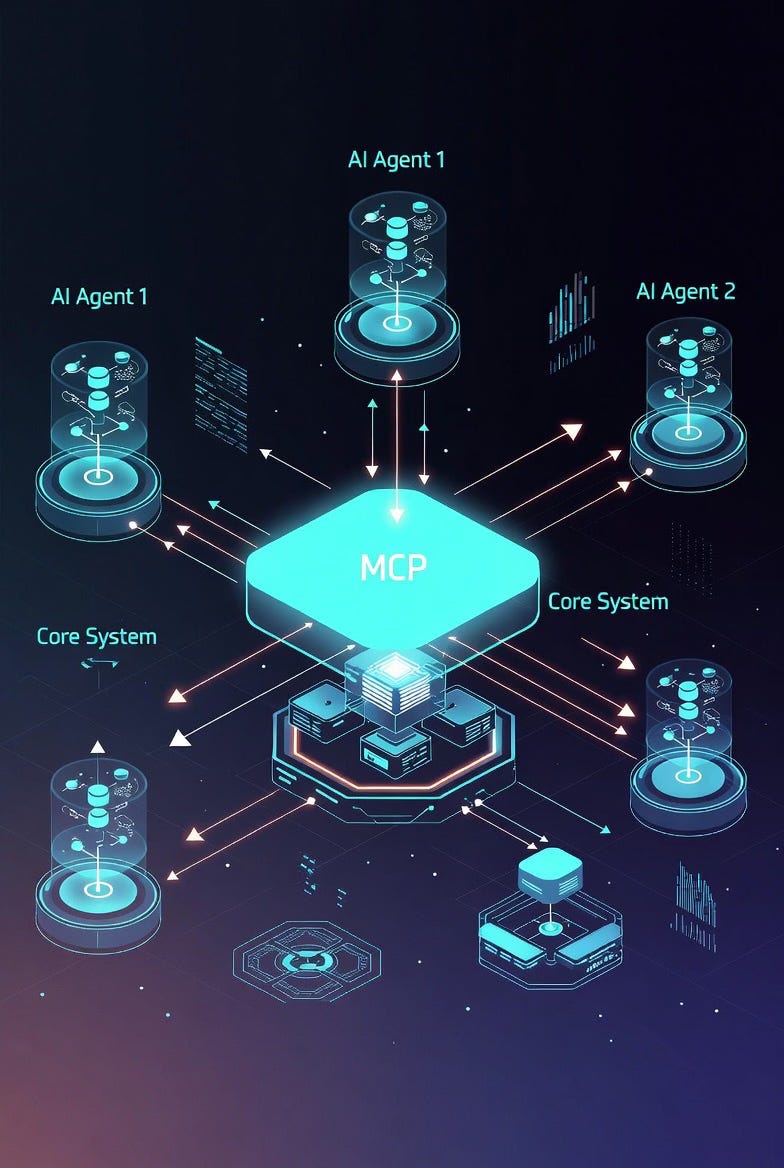
There is a version of this moment where the IBM i community spends the next three years watching AI happen to other platforms.
That version is over.
IBM has built the bridge. The stack is named. The tools are available today. And the people best positioned to use them are the ones who already know the business the stack is built to run.
This issue is about the architecture. Not a roadmap. Not a beta. What exists right now, how the layers connect, and why this platform is not behind — it is ahead of where every other enterprise stack is trying to get.
---
## SIGNAL 09 · THE PROTOCOL SIGNAL
### The Bridge Has a Name. It’s Live.
*IBM, October 2025 → 2026 — IBM releases the IBM i MCP Server. Tech preview shipped at TechXchange 2025. Production-ready documentation published. 500 tools targeted for 2026.*
For years, the practical barrier to connecting IBM i to the modern AI ecosystem wasn’t the data or the logic — it was the interface. There was no standard way for an AI agent to reach into a system running RPG and Db2 and call what it needed. Every integration required a custom connector. Every AI experiment required building the plumbing from scratch.
Model Context Protocol changes that. MCP is the tool protocol — the layer that defines what an agent is authorized to access, execute, and observe. Anthropic designed it as a universal standard, what they call a USB-C port for AI applications. Instead of custom connectors for every tool and data source, one protocol. Any agent. Any framework.
IBM shipped the IBM i MCP Server. First released at TechXchange in October 2025, it has since moved to production-ready documentation and active development under an Apache 2.0 open source license. The goal: 500 tools in 2026. SQL Services. CL Commands. System monitoring. Security auditing. All exposed as callable tools to any MCP-compatible agent.
> “Our team has made an initial version of an IBM i MCP server available, and we’ve set a goal to produce at least 500 tools in 2026.”
*— IBM i MCP Server documentation · IBM · 2025–2026*
The supported client list tells you how seriously IBM is taking this: Claude Code, Claude Desktop, VSCode, Cursor, Windsurf, Roo Code, LM Studio, Gemini CLI, Cline. IBM is not picking winners on the client side. They’re building for the whole ecosystem.
The bridge isn’t coming. It’s here. The question is whether your organization walks across it.
---
## SIGNAL 10 · THE API SIGNAL
### Mapepire: The Db2 You Already Have, Now Callable.
*IBM, 2024–2025 — Mapepire ships as IBM’s open-source database access layer for IBM i. Db2 data and business logic exposed over WebSocket connections. No disruption to what’s running. Multiple agentic frameworks confirmed working.*
The fear that stopped most IBM i modernization conversations was legitimate: you can’t touch what’s running. The business depends on it. Any API layer that requires rewriting the core to expose it isn’t a bridge — it’s a migration in disguise.
Mapepire is different. It sits above the Sovereign Core — RPG and Db2 stay exactly as they are. Mapepire makes them callable via WebSocket, optimized for the request-response patterns AI agents actually use. Traditional access methods like ODBC and JDBC weren’t designed for the frequent, short-lived queries that agentic systems require. Mapepire was.
Multiple agentic frameworks are confirmed working with IBM i via Mapepire today: LangChain, Agno, and the MCP protocol itself. BeeAI and CrewAI are in progress. The ecosystem is not locked to a single vendor or approach. The platform is connectable to wherever the agentic world is going — and more frameworks are joining the list.
The IBM i MCP Server requires Mapepire as its foundation. They are not separate tools — they are the two layers of the same bridge. Mapepire handles the database connectivity. MCP handles the agent interface. Together they are the integration layer the IBM i community has been waiting for.
> “Mapepire bridges the gap by providing a modern, WebSocket-based SQL query interface that’s optimized for the request/response patterns of AI agents and MCP tools.”
*— IBM i MCP Server documentation · IBM · 2025–2026*
Seiden Group, one of the IBM i community’s most respected independent consultancies, announced production support for Mapepire in July 2025 — noting that many developers are already relying on it as the back-end to the Db2 for i extension for VS Code, sometimes without realizing it. That is what mainstream adoption looks like: it arrives quietly, then all at once.
The data didn’t have to move. The bridge came to it.
---
## SIGNAL 11 · THE STACK SIGNAL
### The Four Layers Are Named. All of Them Exist Today.
*IBM · Open Source and AI — The complete IBM i agentic stack specified and demonstrated. Four layers. Each named. Each available now.*
The conversation about modernizing IBM i used to require an act of imagination. What would the architecture look like? What would it cost to build? How long would it take?
That conversation is over. The stack is specified. Here are the four layers, from the ground up:
**Layer 1 — The Sovereign Core.** RPG and Db2. Untouched. Thirty years of business logic, transaction integrity, and operational reliability. This is the moat. It doesn’t move. No competitor can buy it. No migration preserves it.
**Layer 2 — The API Layer.** Mapepire. Node.js on PASE. The Sovereign Core becomes callable. Business logic and Db2 data exposed over modern interfaces without disturbing production operations. The bridge runs alongside the system — not through it.
**Layer 3 — The Agentic Layer.** Python orchestration — LangChain or Agno. An Orchestrator Agent that routes, plans, and reasons. Specialist agents that execute. The MCP protocol bridge connects agents to the tools they’re authorized to use. The overnight batch job becomes an observable, auditable, agent-driven process. The Think → Act → Observe loop runs against your own data, in your own environment, under your own governance.
**Layer 4 — The Modern Surface.** React or Next.js. Business users interact with the system through an interface that speaks their language. Configuration in hours, not tickets. System behavior changes without requiring a development cycle. The prompt is the interface.
> “Each layer has a distinct responsibility. MCP is the protocol bridge, not the orchestrator. Nothing bleeds across the boundary.”
*— IBM i Agentic Architecture · IBM · 2025–2026*
This is not a future state. It is the current state for organizations that have made the decision to move. The stack is here. The question is the decision.
---
## SIGNAL 12 · THE NATIVE SIGNAL
### The Stack Is Still Expanding.
*IBM, 2025 — IBM develops an experimental SDK that lets RPG programs call AI models directly via embedded SQL. No new language. No new architecture. One SQL function connects existing business logic to any LLM endpoint. Currently in active development.*
The four-layer stack above is deployable today. But the ecosystem around it is still growing — and the signal worth watching is what happens when the integration moves from the outside in.
IBM is developing an experimental SDK that would let developers call AI models directly from Db2 for i — and by extension from RPG via embedded SQL. The concept: a SQL function call connects existing business logic to any LLM endpoint. IBM watsonx, Ollama, any OpenAI-compatible solution, on-premise inference options — all reachable from inside the RPG codebase itself. No new language. No new architecture layer. One function call.
The SDK is currently documented as experimental and not yet production-ready. IBM’s own GitHub describes it as “in bringup state.” But the direction is clear, and the implication matters:
If this ships, existing RPG code participates in AI workflows without a rewrite. The 30 years of business logic encoded in that codebase doesn’t have to be migrated, translated, or replaced to become part of an agentic system. It calls the agent. The agent calls it back.
The organizations that understand the four-layer stack now will be best positioned to extend it when this capability arrives. The ones that wait for the complete picture will be starting from scratch at that point.
The core stack is here. The ecosystem is still expanding. This is the signal that tells you both things are true.
---
## What This Means
Four signals. One conclusion.
The IBM i MCP Server is live and in active development. Mapepire is the foundation multiple frameworks already run on. The four-layer stack is specified and deployable today. And IBM is building the next layer — native AI calls from RPG — with production readiness on the horizon.
The bridge is built. The stack is named. The tools are available.
What’s missing is not technology. It is not the platform. It is not the people.
What’s missing is the posture. The organizational decision to treat this as the moment it is — and to move before someone else names what you have and builds on top of it without you.
---
## Vol. 4 — The Execution Signal
Architecture doesn’t deploy itself.
The gap between a named stack and a running agent is where most organizations stall. The technology is ready. The platform is ready. And yet 95% of GenAI pilots are failing. 26% of scaled experiments reach production. 77% of organizations have no committed agentic AI strategy.
That gap has a name now too: the Forward Deployed Engineer. The market has begun quantifying the distance between AI architecture and AI deployment — and pricing it accordingly. Vol. 4 is about what the execution gap actually looks like, what closes it, and why the IBM i practitioner is already holding the most important piece.
Next issue: The Execution Signal.