
Signal4i Intelligence · Field Note 07
Partners not Employees

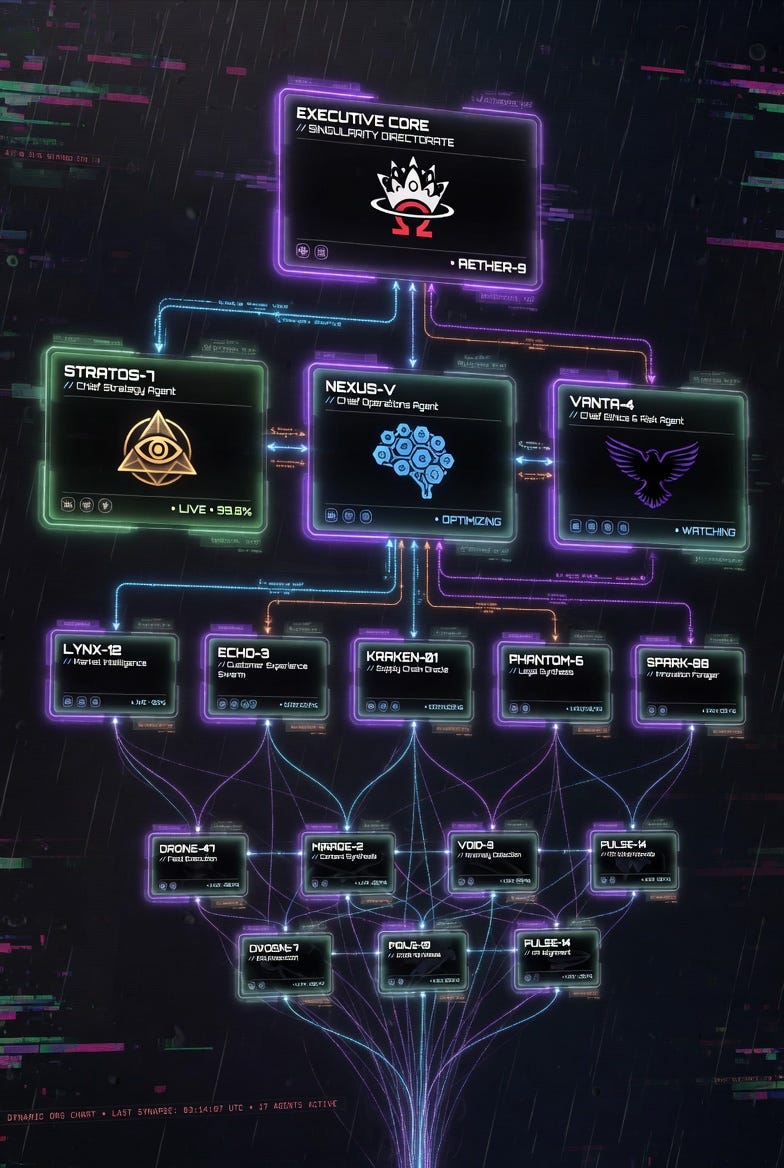
Thirty-one percent of organizational leaders are now placing AI agents on their org charts as employees.
BCG ran a randomized experiment on what happens when you do that. The results weren’t ambiguous.
Accountability diffused. Escalation increased. Review quality dropped. Professional identity eroded. And adoption intent — the metric that actually matters — didn’t move at all.
Four failure modes. Zero upside.
But here’s the thing: the naming error isn’t the problem. It’s a symptom. The problem is the structure the label is being applied to.
Most organizations adopting agentic AI are bolting agents onto structures designed for human coordination, human information flow, and human decision latency. The agents don’t fail because they’re agents. They fail because the org wasn’t built for what agents are.
You can’t bolt agents onto a legacy org any more than you can bolt a jet engine onto a horse. The horse doesn’t become faster. It becomes a different kind of broken.
Salim Ismail calls the threshold where this becomes fatal the Organizational Singularity — the point at which intelligence infrastructure replaces hierarchy as the primary coordination mechanism. The firms that cross it were redesigned before the agents arrived. The firms that didn’t are holding up rubble with the org chart they had in 1987.
The full field note — four failure modes, Microsoft’s four-mode human-agent collaboration model, the relic condition, and what agent-ability actually requires — is live now at Signal4i.
Signal4i publishes field intelligence for practitioners and leaders navigating the AI economy.
The next piece — on how to think about the human-agent aspect — is coming at reggiebritt.ai